
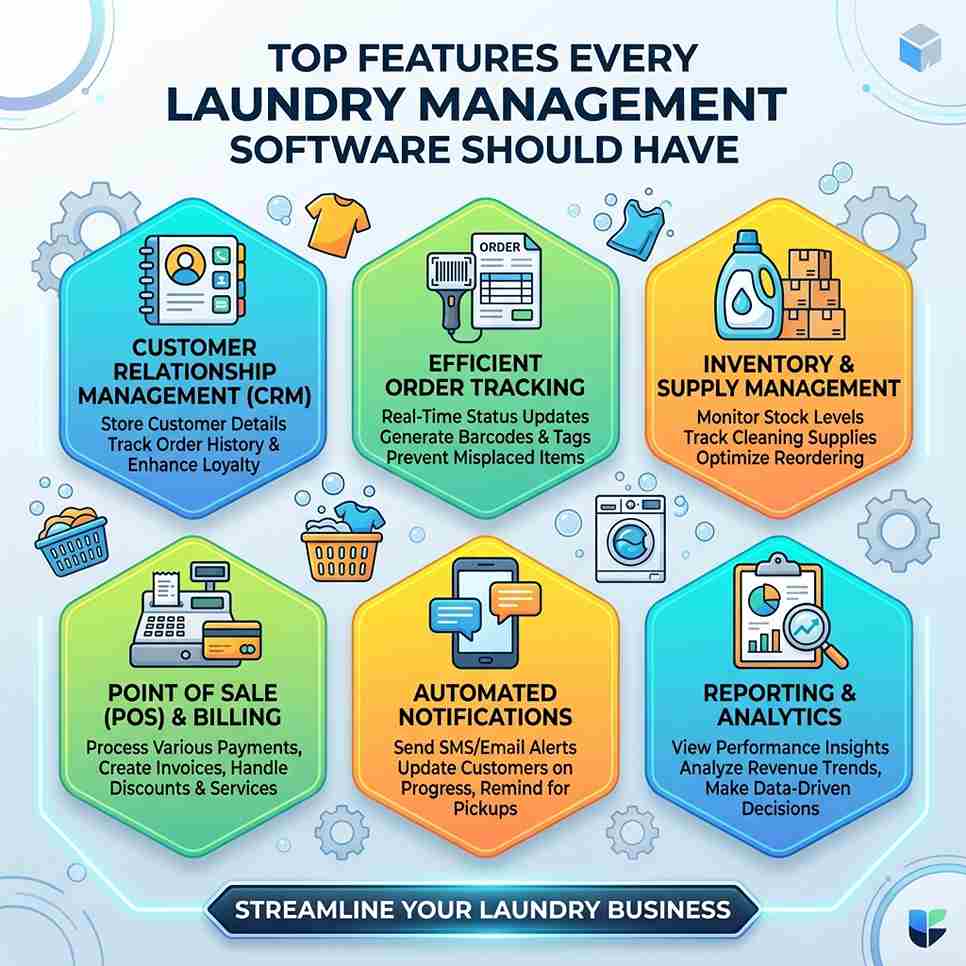
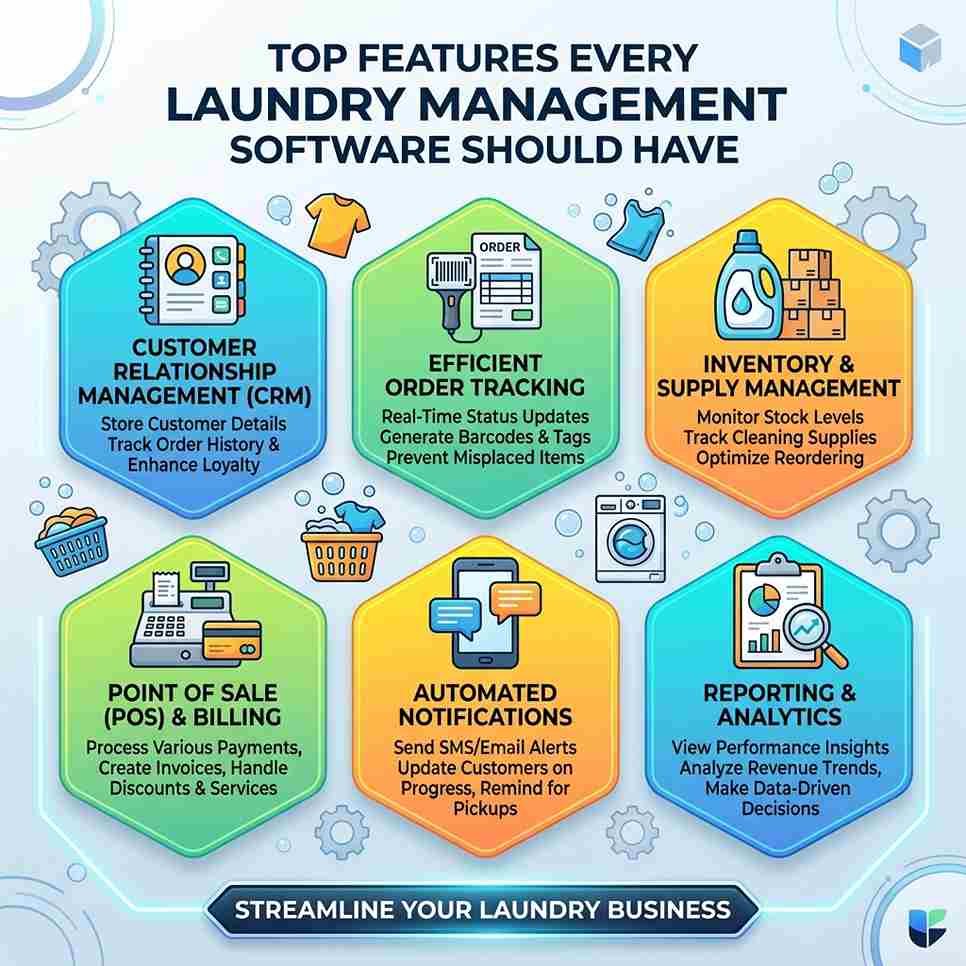
Top Features Every Laundry Management Software Should Have
10 Must Have Features in Laundry Management Software

Choosing laundry management software is one of those decisions that feels straightforward until you actually start comparing options. Every platform claims to do everything. Every demo looks impressive. And yet, six months after committing, plenty of business owners find themselves working around the software rather than with it, paying for features they never touch while missing the ones they genuinely need.
The truth is that the best laundry software is not the one with the longest feature list. It is the one with the right features, built specifically for how laundry and dry cleaning businesses actually operate. A generic point of sale system bolted onto a laundry workflow will always feel slightly wrong, because it was never designed for the realities of pickups, turnaround times, and garment tracking.
So before you sign up for anything, it helps to know exactly what to look for. Here are the features that genuinely matter, and why each one earns its place.
This is the foundation, and if a platform gets it wrong, nothing else matters.
From the moment a customer places an order to the moment clean items are returned, every step should be visible and trackable in a single system. That means tagging items, tracking their status through cleaning and finishing, and knowing instantly where any order is at any time.
Good order management eliminates the small failures that quietly cost you customers: lost tickets, duplicate entries, items that get mixed up between orders, and the awkward moment when a customer asks about their garments and your team has to go searching. When every touchpoint is connected, your whole operation stays aligned, whether it is one person behind the counter or a team spread across processing and delivery.
Knowing your customers is not just good service, it is good business.
Software that stores customer profiles, preferences, and full order history lets your team deliver a more personal experience without relying on memory. You can see what a regular usually brings in, note specific instructions for delicate items, and resolve any dispute quickly because the record is right there.
Over time, this data becomes one of your most valuable assets. It tells you who your best customers are, how often they use you, and where there is room to do more. A platform that treats customer history as a core feature rather than an afterthought is one worth taking seriously.
If customers still have to phone during business hours to arrange a pickup or drop off, you are losing the ones who simply will not bother.
Online and app-based booking is now the baseline expectation. People schedule taxis, tables, and grocery deliveries from their phones in under a minute, and they expect the same from a laundry service. Good software lets customers book collections, choose time slots, and set up recurring orders without ever picking up the phone.
This does more than satisfy customers. It reduces the inbound call volume that ties up your staff, and it captures orders that would otherwise have gone to whoever made booking easier.
One of the top reasons customers switch services is the feeling of being left in the dark.
Where is my order? Is it ready? When will it arrive? If answering those questions requires a phone call and a hold, that is friction. Automated notifications solve it. When a customer is told their order has been received, is being processed, is ready, or is out for delivery, they feel looked after, and they stop calling to ask.
This is a feature that improves satisfaction and reduces workload at the same time, which is a rare and valuable combination.
Billing is where trust is quietly won or lost.
Incorrect charges, vague invoices, or a clunky payment process erode confidence fast. A customer who feels overcharged, even by mistake, often does not come back. The right software makes billing fast, accurate, and flexible. Customers should be able to pay online, receive clear digital receipts, and never have to wonder what they were charged for.
Look for support for multiple payment methods, automated invoicing, and the ability to handle accounts for commercial or recurring customers cleanly. Flexible, transparent billing is not a luxury feature, it is a retention feature.
For any business offering collection and delivery, logistics can make or break the operation.
Software with built-in delivery management helps you plan routes, assign jobs to drivers, and keep customers updated on arrival windows. Late pickups with no warning are one of those small frustrations that push customers elsewhere, so a system that coordinates this side of the business efficiently is increasingly essential rather than optional, especially in busy urban markets where competition is dense.
If you cannot see which services are most profitable, which days are busiest, or where your bottlenecks are, you are running on guesswork.
Good reporting turns your daily activity into usable insight. You can see your revenue trends, identify your most valuable customers, spot quiet periods worth promoting into, and understand which parts of your service mix actually make money. Businesses that run on real data consistently make better decisions about pricing, staffing, and marketing than those running on intuition, and that advantage compounds over time.
You do not need a data science degree to benefit from this. You just need software that presents the numbers clearly.
Your team is part of the operation, and managing them should not require a separate set of tools.
Scheduling, task assignment, and productivity tracking built into the same platform reduces miscommunication and keeps everyone aligned. When tasks are assigned clearly and progress is visible, you spend less time chasing and more time running the business. It also helps maintain consistency, so customers get the same quality experience regardless of which staff member handles their order.
Business owners rarely sit behind a single desk all day.
Software that works reliably across devices and can be accessed remotely lets you keep an eye on the business from anywhere. And if you operate, or plan to operate, more than one location, multi location support becomes critical. A platform that works well for a single shop but cannot scale will become a ceiling on your growth. Choosing one that can grow with you saves a painful migration later.
No software exists in isolation.
The best platforms connect with the other tools you rely on, whether that is accounting software, marketing tools, or payment providers. Integrations reduce double entry, cut down on errors, and let information flow between systems instead of trapping it in silos. Before committing, it is worth checking that a platform plays nicely with the tools already central to your business.
A long feature list is easy to be impressed by. The harder and more useful exercise is working out which features matter most for your specific operation.
Start with clarity about what is costing you right now. Is it the booking process? Communication during order processing? Billing? Lost orders? Identifying your biggest friction points first makes evaluating platforms far more straightforward, because you can judge each one against the problems you actually have rather than a generic checklist.
Then look for providers who understand the laundry industry specifically, not just point of sale systems in general. A platform built for laundry and dry cleaning comes with workflows and terminology your team already recognises, which dramatically shortens the learning curve. Proper onboarding support matters too, because even the best software fails if no one is helped to use it well.
The features that make laundry management software genuinely valuable are not the flashiest ones. They are the ones that remove friction from the everyday work of running your business: connected order tracking, customer history, easy booking, automated updates, clean billing, reliable delivery coordination, and clear reporting.
Software does not replace the quality of your cleaning or the care your team brings to each order. What it does is make sure customers experience that quality without obstacles, while giving you the data and time to run a stronger business. When you are comparing options, judge them not by how much they claim to do, but by how well they handle the things your business does every single day.
 WhatsApp Business Integration for UK Laundry Shops - What to Know in 2026
27 Apr 2026
For any business evaluating laundry management software UK providers o...
 Best Laundry Software with WhatsApp Notifications for UK Shops
27 Apr 2026
If you are evaluating laundry management software UK businesses rely o...
 Free Laundry Software vs Paid: True Cost Comparison for UK Dry Cleaners
25 Apr 2026
If you are searching for laundry management software UK businesses use...
 Best CleanCloud Alternatives for UK Dry Cleaners 2026
17 Apr 2026
Running a dry cleaning or launderette business in the UK gets harder e...
 Laundry EPOS Software UK 2026 Top Systems Compared
09 Apr 2026
Laundry EPOS Software UK 2026 Top Systems Compared
Laundry management software is a platform that connects your orders, customer data, payments, staff workflows, and delivery operations in one place. It replaces manual processes and disconnected tools with a single system built for how laundry and dry cleaning businesses operate.
Order management that connects every touchpoint is the foundation. If the software cannot reliably track an order from drop off to return in one place, the other features matter far less. Beyond that, the most important features depend on your biggest pain points, whether that is booking, billing, or delivery.
For most modern laundry businesses, yes. Customers now expect to book from their phones and receive updates automatically. These features reduce inbound calls, capture orders that would otherwise be lost, and improve satisfaction, all of which support customer retention.
Start by identifying where you are losing customers or wasting time right now. If your biggest issue is missed pickups, prioritise delivery management. If it is billing disputes, prioritise invoicing. Matching features to your real friction points is far more effective than choosing the platform with the longest list.
10 Must Have Features in Laundry Management Software

There is a moment every laundry business owner dreads. A regular customer stops coming in. No complaint, no explanation, they just disappear. You assume they moved or got busy. But the truth, more often than not, is simpler and more fixable: the experience was not convenient enough, and someone else made it easier.

The laundry industry is evolving quickly as customer expectations continue to rise. Customers want faster service, better communication, easier booking experiences, and more convenience. Many laundry businesses still focus only on cleaning quality and delivery speed, but long term growth now depends on operational efficiency and digital experiences.