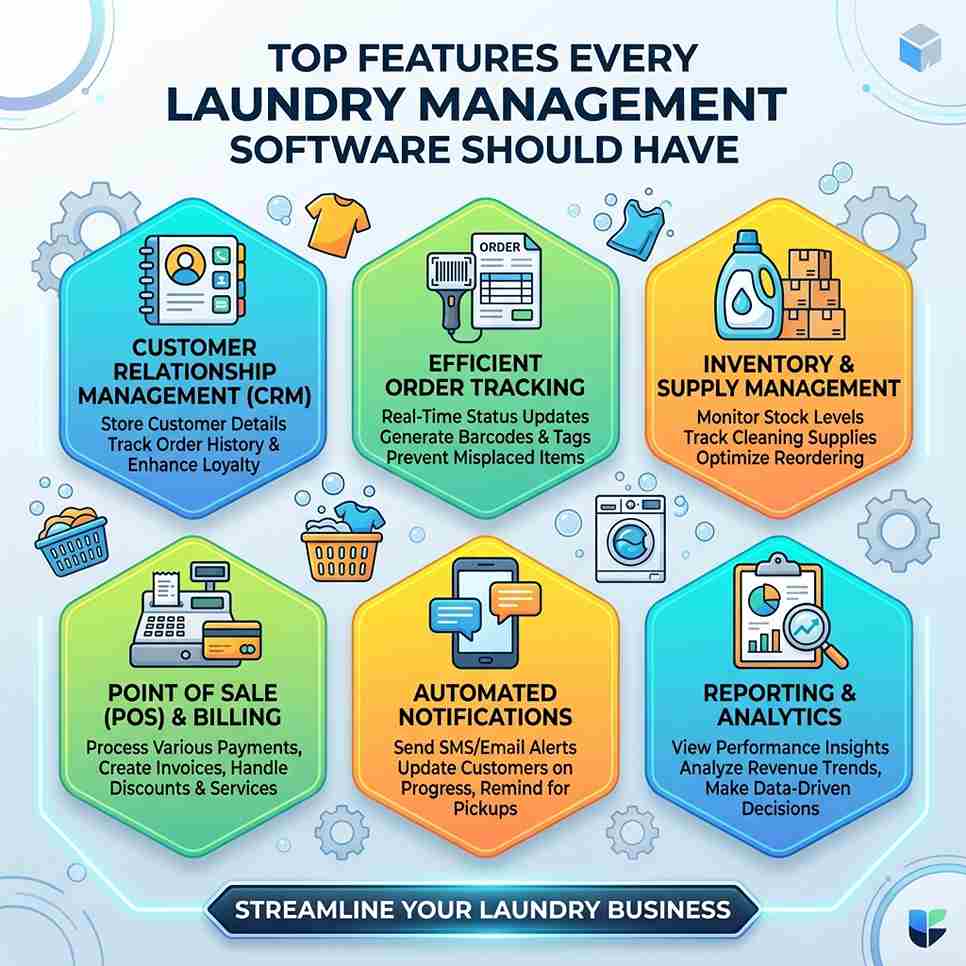
Top Features Every Laundry Management Software Should Have
10 Must Have Features in Laundry Management Software



For any business evaluating laundry management software UK providers offer, barcode and tag printing is no longer just a feature. It is a core operational requirement. In fact, many dry cleaners make their final purchase decision based on how well a system handles garment tagging and barcode tracking.
Every day, laundries handle dozens or hundreds of similar looking garments. Without a reliable tagging system, errors increase, items get misplaced, and customer trust drops. Barcode-enabled dry cleaning software solves this by creating a structured, trackable workflow from intake to delivery.
This blog explains what really matters when choosing barcode and tag printing capabilities, so you can avoid costly mistakes and select a system that supports long term growth.
Manual tagging methods are no longer sustainable for modern laundries.
Accurate identification of each garment
Faster order processing and sorting
Reduced lost or misplaced items
Real time tracking across stages
With a properly integrated laundry POS system, every scanned item updates automatically, reducing manual work and improving consistency.
In the UK market, where customer expectations are high and turnaround times are tight, barcode tagging directly impacts service quality and repeat business.
Understanding printer technology is essential before making a decision.
Lower upfront cost
No ribbon required
Suitable for short-term labels
Limitations:
Labels can fade with heat or moisture
Not ideal for long processing cycles
Uses ribbon for printing
Produces durable, long-lasting labels
Resistant to water, heat, and chemicals
This is the preferred option for most UK dry cleaners because labels remain readable throughout the cleaning process.
The quality of the tag is as important as the printer.
Paper tags for basic usage
Synthetic labels for durability
Heat-seal labels for permanent tagging
For businesses handling repeat customers or high volumes, synthetic or durable tags reduce reprinting and improve efficiency.
Poor quality tags lead to:
Scanning failures
Misplaced garments
Increased manual corrections
Hardware alone does not solve the problem. The real value comes from integration.
Your laundry booking system and POS must:
Automatically generate barcodes during order entry
Link each tag to customer and garment details
Update status at every scan point
Sync with delivery and packing workflows
Without full integration, staff will rely on manual processes, defeating the purpose of barcode automation.
The best laundry SaaS platforms combine barcode tracking with billing, delivery, and customer management in one system.
A well-designed barcode system should support scanning at every stage:
Tag is printed and attached to garment
Items are scanned and grouped
Status updates to in progress
Items verified before dispatch
Final scan confirms completion
This structured workflow eliminates confusion and ensures accountability at every step.
When evaluating barcode-enabled best laundry software, focus on these features.
Instant updates when items are scanned, reducing customer queries.
Staff should be able to scan using handheld devices or mobile apps.
System should detect mismatched scans and prevent incorrect processing.
For growing businesses, tracking across stores and delivery routes is essential.
Data on order accuracy, processing time, and error rates helps improve operations.
Cheap printers often lead to higher long-term costs due to poor durability.
Low-quality tags result in scanning issues and operational delays.
Without integration with a laundry delivery app, tracking breaks during pickup and drop-off.
Complex workflows reduce staff adoption and increase errors.
A system that works for 30 orders per day may fail at 100.
A mid-sized dry cleaner handling around 70 orders daily switched from manual tagging to barcode-based tracking integrated with their POS.
Within a few months, they experienced:
Significant reduction in lost items
Faster sorting and packing
Fewer customer complaints
Improved staff productivity
This highlights how barcode tagging directly improves both operations and customer experience.
The technology continues to evolve in 2026.
Smartphones are increasingly replacing dedicated scanners.
Businesses are using both formats for flexibility.
Systems automatically flag inconsistencies in workflows.
High-volume laundries are exploring RFID for faster bulk processing.
Barcode and tag printing is not just a technical feature. It is the foundation of efficient laundry operations.
The right system will:
Reduce errors and lost items
Improve processing speed
Enhance customer experience
Support delivery and scalability
If your current setup relies on manual tagging or disconnected systems, upgrading to a fully integrated barcode solution is one of the most impactful decisions you can make.
When selecting laundry management software UK businesses rely on:
Prioritise durable printing and tag quality
Ensure full integration with POS and workflows
Choose a system that supports delivery and scaling
A strong barcode system does more than track garments.
It gives you complete control over your operations, from intake to delivery, and sets the foundation for long-term growth.
 WhatsApp Business Integration for UK Laundry Shops - What to Know in 2026
27 Apr 2026
For any business evaluating laundry management software UK providers o...
 Best Laundry Software with WhatsApp Notifications for UK Shops
27 Apr 2026
If you are evaluating laundry management software UK businesses rely o...
 Free Laundry Software vs Paid: True Cost Comparison for UK Dry Cleaners
25 Apr 2026
If you are searching for laundry management software UK businesses use...
 Best CleanCloud Alternatives for UK Dry Cleaners 2026
17 Apr 2026
Running a dry cleaning or launderette business in the UK gets harder e...
 Laundry EPOS Software UK 2026 Top Systems Compared
09 Apr 2026
Laundry EPOS Software UK 2026 Top Systems Compared
Barcode and tag printing is no longer optional—it’s the backbone of garment tracking. Every item gets a unique identity, allowing laundries to monitor it through washing, drying, ironing, and delivery. This reduces mix-ups, improves speed, and ensures full traceability.
Laundry environments involve water, heat, chemicals, and friction, so standard paper labels won’t work. You should look for:
Waterproof or “wet ticket” tags
Heat and chemical-resistant materials
Tear-proof labels
These tags are designed to survive the full cleaning cycle without fading or falling off.
UK dry cleaners typically use three main approaches:
On-demand printing: Tags printed per order with barcode and garment details
Pre-printed barcodes: Bulk-printed tags assigned later
RFID or permanent tags: Used for large-scale or repeat-use operations
Each method has pros and cons depending on your volume and workflow.
Your printer choice directly affects durability and cost:
Thermal printers: Fast, low maintenance, ideal for most modern laundries
Thermal transfer printers: Better for long-lasting, high-durability tags
Impact printers: Still used in some legacy systems but less common
The key is ensuring the print remains readable after multiple wash cycles.
Your laundry software should seamlessly connect with your printing system. Look for:
Auto-printing tags during order creation
Integration with POS and barcode scanners
Cloud-based tracking and history
Multi-store print management
A fully integrated system reduces manual work and eliminates labeling errors.
10 Must Have Features in Laundry Management Software

There is a moment every laundry business owner dreads. A regular customer stops coming in. No complaint, no explanation, they just disappear. You assume they moved or got busy. But the truth, more often than not, is simpler and more fixable: the experience was not convenient enough, and someone else made it easier.
The laundry industry is evolving quickly as customer expectations continue to rise. Customers want faster service, better communication, easier booking experiences, and more convenience. Many laundry businesses still focus only on cleaning quality and delivery speed, but long term growth now depends on operational efficiency and digital experiences.